We are hauling it in Trinidad this week. We’ve been traveling since 2022, have about 15K, and have never serviced the sail drives (SD60). I’ve not had any problems with them and the oil looks fine. Should I get the seals serviced? A friend says no, he has 15 years on his with no problem, and touching them might even cause problems. Our current plan is to head to Guatemala in 3-4 months.
check /replace the Zincs anodes. except for visual inspection of the membrane and looking for corrosion, the membrane lifetime is 7 years. so none
1 Like
The Yanmar service manager in Cape Town told me to only service them if they fail … let the sleeping dogs lie!!!
1 Like
That’s probably fine if you sail locally, but if you’re a long distance cruiser, I would service regularlly.
Steve probably has sailed more than us all…he doesn’t do local…
2 Likes
Classic chirp Don! … What I would add is definitely carry spare seal sets for the sail drives as Murphy will make sure that if you do have a failure the haul out spot will probably not have any spares in stock or worse try and fit the wrong seals 
I suppose a lot depends on what we mean by “service” - there is more than one aspect to that.
Firstly - monitoring the oil in the sail drive regularly, - mainly looking for it turning milky coloured which is a sign of water/oil emulsion. If it goes milky then the odds are the seals have failed. Seals tend to fail if fishing line gets around the shaft and works its way in to the seal - so not necessarily based on age of seals etc.
Next, oil changes. There is a service interval for the oil in the drive to be changed. I tend to do this when I do the engine oil change (every 250 hours) - it should look like new - but I change it anyway - oil is very cheap compared to a saildrive. We use a vacuum pump to get as much as possible out (not perfect). The oil level is measured with the dip-stick unscrewed.
I don’t proactively change shaft seals reguarly - but if I was out of the water already I may consider it.
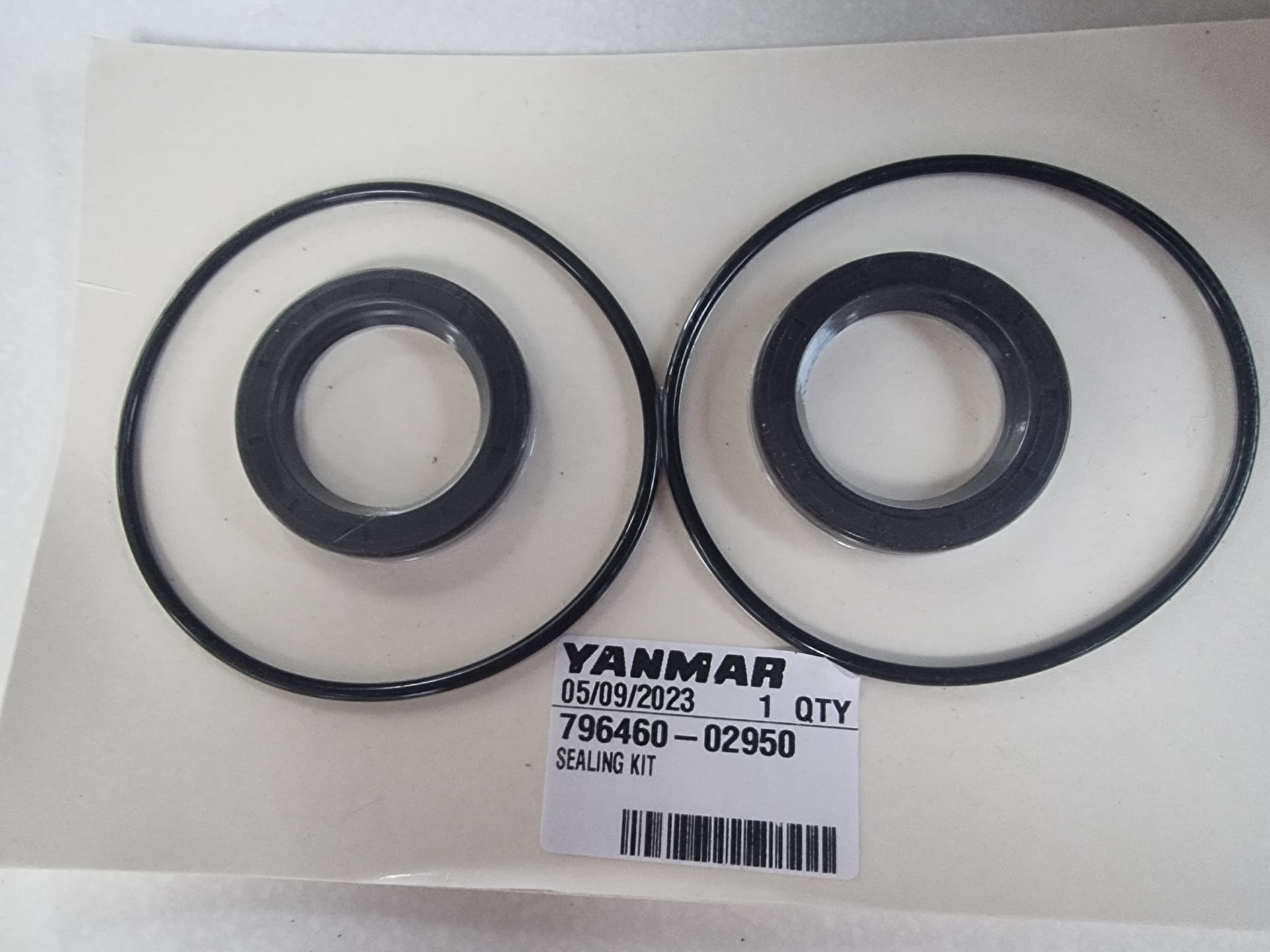
We do carry (two) spare seal sets for exactly the scenario Tsalta outlines. I have never needed to use mine but I did help a friend out with a set which got them relaunched on time saving hundreds of $ in additional boatyard fees whilst spares were ordered. Even if there is a local Yanmar dealer they won’t necessarily have any stock.
On the theme of seals there is a diaphragm that seals the top of the saildrive but permits flexibility. That has a service life but I know many people who go way past that. I’m not sure how an insurance company would feel about a time expired diaphragm that caused a problem…
On the Yanmar diaphragm there is a sensor that monitors for water ingress - the engine display panel will give a “water in seal” alarm if any is detected.
Then finally as Udy says there are Anodes to monitor and replace. My boat came with full ring Anodes  that require the prop to be removed to replace them… On my first haul, I replaced those with Yanmar split ring anodes which can be changed in the water. I had to change an anode in the water this week. (In hindsight I should have asked KYC to fit split ring anodes - I never imagined they wouldn’t). Part no is 196450-02492 - for the ALU anode option.
Without the anode the aluminium of the saildrive can easily become the (very expensive) anode itself and corrode.
So whilst the saildrive is not a big maintenance item there are things to keep an eye on.
There are shims behind the seals in the housing, or you can put shims in. The purpose of these shims is to move the seals a little, to keep them running on new metal in the prop shaft. The prop shafts are actually reasonably soft and will mark. If there is a grove in the prop shaft it’s quite important to move the seals to a fresh position on the shaft. The movement of the seal to a new position, is almost as important as changing the seal.
If you have groves in your prop shaft that aren’t too deep, it’s wise to plan on machining the prop shafts when you next slip.
1 Like
Excellent post Mike … Have you actually done this to your shafts and do you recall how much was machined off the shaft?
One prop seal leaked. It was right after an in water oil change on the sail drives. We hauled and went to replace the prop seals when we found deep groves in the shafts. A friend has spent a lifetime working on outboard race boats. He looked at them for me. He spray welded and machined them for me. It was a very quick process. He was really well setup .
As for the cost… I’m not sure of the real price. But I got him a bottle of single malt.
He was the one that stressed the shims to prevent groves. Once there are groves, there are 4 options. A speedy sleeve, Tig weld and machine, spray weld and machine, or replace the shafts and reshim the gearbox.
Another interesting view is that the gearbox is sealed. There is actually a caution note about opening the dipstick when it’s hot, as there will be pressure inside the gearbox from air expanding. If there is the slightest fault in the seals, oil will squeeze past the seals under pressure while it is running. Then, when it cools down, there will be a negative pressure that will actually suck water into the gear box. They are seals, not really pressure seals. The solution is to put a breather on the top of the gearbox. It is quite a common modification. I have put breathers on my gearboxes. So far, so good..
Hi Mike
Thanks for this update, it is very interesting, especially the part about opening the transmission oil dipstick cover. I found an interesting article on this a few years back on the cruising forum and bought the parts for this modification over time (as the replacement oil filler cap was not readily available ) Well I now have all the parts (with one potential additional modification still in play and I would welcome your comment in this regard … see further down in the email below)
This modification was developed by a guy who had endless problems with the Yanmar SD50 sail drives …….. I have the SD60 which has supposedly resolved the main issues with the seals on the SD50 …….. That said ….. I have had to replace my seals after 4 years on both due to the incredible barnacle growth I picked up anchored in the inter coastal of West Palm Beach for 10 days which caused the one drive to fail by the time I got to Charleston and the other when I got to Norfolk on the Chesapeake Bay by turning the small barnacles into a viscous rubbing compound that basically ate through the seals! ….. I recently had the port one fail again since arriving in the Med after just over 100 hours of use …… for no apparent reason (as there was nothing snagged on the seal and no sign of melted plastic or fishing line which are the usual culprits! I have 1800 hours on my engines after 6 years and 30 000nm.
So here is the modification I am planning to do when I haul out in Greece in early October 2025.
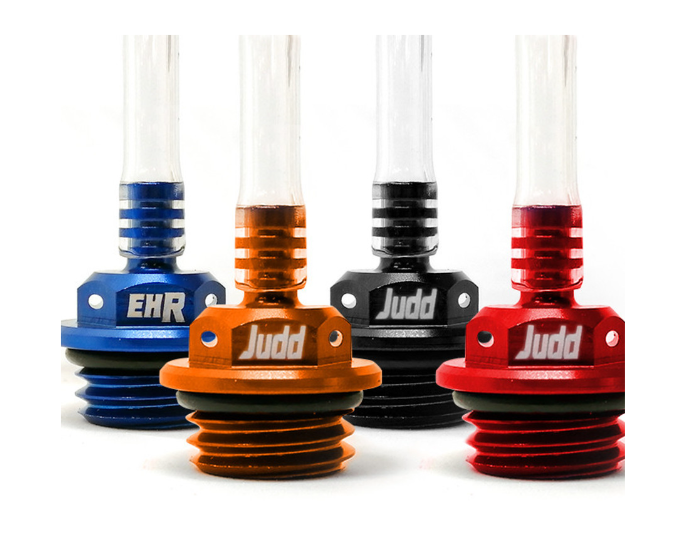
- I am replacing the orange Yanmar filler cap/dipstick combo with these blue billet aluminium oil caps that have a nozzle on them (they are made for KTM offroad motorbikes and have the identical thread). See photo 1
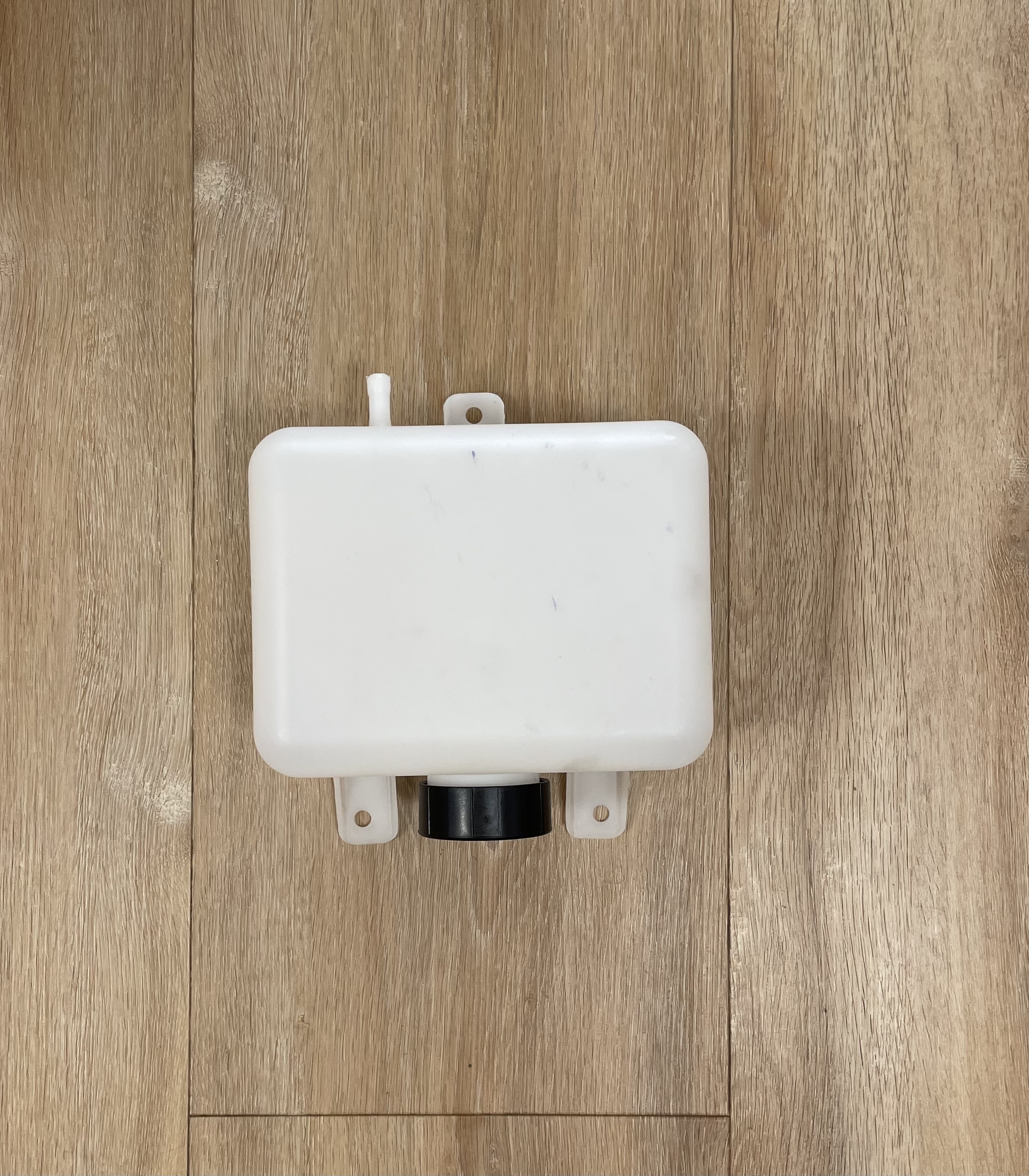
- I am then going to connect a pipe from the nozzle to a header tank that will be easily accessible in my engine bay (for me to get my transmission oil caps requires some minor boat yoga! See photo 2
- The positives of this set up is I can easily check the oil level without actually having to get into the engine bay (which are under our beds in the stern)
- I can also determine at a glance, through the plastic opaque header tank if the seal is gone by having a permanent visual of the oil colour and level.
- To fill up the sail drive with oil is now much easier due to accessibility.
- It is very important (as you know ) to not OVERFILL the transmission with oil as it puts extras strain on the seals. (the SD60 takes 2.8 litres of oil) With the header tank this is far less of an issue as the header tank will also act as an expansion box.
- So here is the one outstanding thing I am still researching ….. I checked my transmission oil temp (with a laser thermometer) after motoring for 3 hours on a very hot day and the temperate was only 41 degrees Celsius ….. so I am planning on not using the black fuel pipe from the nozzle to the header tank that I originally bought, but fly back to SA I am going to try and find a clear or transparent pipe that is strong enough to take the heat and not be affected by the oil so that the visual of checking the level and colour becomes a non-event and also helps monitor the oil level especially when changing the oil.
- It was amazing that when I picked the brains of two different qualified Yanmar mechanics about this setup ….. neither were prepared to comment on it and sat on the fence, even when I said I was prepared to sign a waiver to not hold them responsible for any future issues and just to get their professional input off the record ….. neither would …… Bloody spineless gits !!! I have subsequently spoken to others who are well qualified in this regard and all of them said it was a great modification.
- Another big positive of this setup is that should a seal fail it is FAR EASIER to top the transmission oil up while on a passage if the oil level starts to drop ……. And to check that the level is actually dropping!
- I will post photos of the setup once installed .
- Check photo 3 for the details of the filler cap from Judd Racing in the UK
Cheers
Steve.
There is a yanmar fitting that is used to suck the oil from the gearbox . I have actually just used that fitting for my breather and header tank.
Every time you think you have seen it all, someone come up with something even more out of the box. … I saw a video of someone replacing the prop seals under water!!
Yep they anchored as shallow as they could, drained the oil by sucking it out, filled the gearbox with water to float the reso do the oil out then sucked it out again.
Then removed the prop and shaft while the boat was in shallow water. They replaced the seals and re fitted the shaft and prop. The gearbox was full of water, so they sucked it out. Then they filled the gearbox with oil, ran it, replaced that oil and the job was done.
Obviously they had good skills. They were very remote with zero chance of a haul out.
An interesting solution. Their thinking was the gearbox already had water in it, so they had nothing to loose. After replacing the seals on my gearboxes, I wouldn’t want to do it underwater! But.. hey, they did it!
That sure is impressive to do that seal change … no way that is happening in the Med with a 30cm tidal range on a spring tide today!
I also saw that done in the marina in Cape Verdes when we were there.
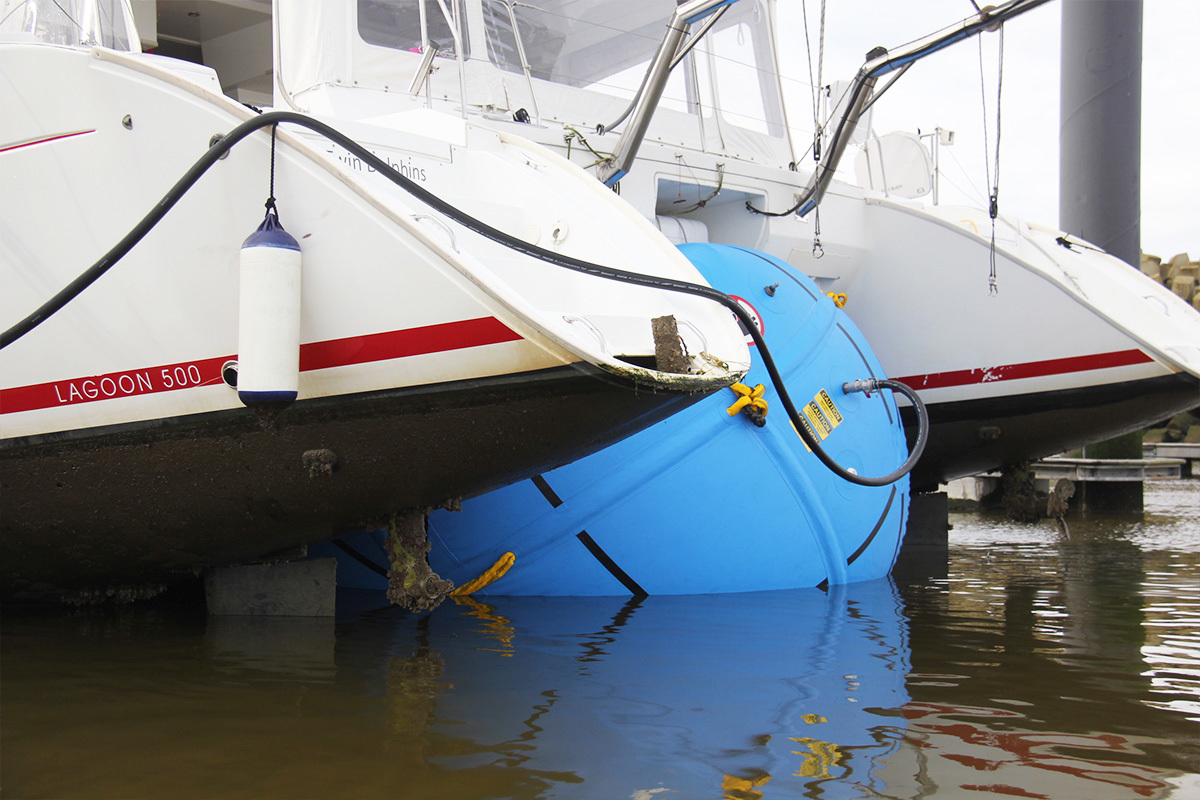
When we were in Tahiti they used a big inflatable bag to lift catamarans to get to the saildrive. I didn’t get a photo but the one below is similar.
whats wrong with US boatyards?
Hello all
I am probably one of the few who hasn’t quite figured out which sealant, caulk etc to use where and when. You would think that after having owned a sailboat for almost 20 years, I would have mastered this topic. I can say, I have tried most of them and still do not always pick the right stuff.
Maybe we could have an opinion (experience) poll so feel free to opine. Here are some of my problem projects. Please add yours and what your best solution is.
Fiberglass:
-
Hair line cracks-what do you use? I have been using the 3M premium 2 part system because that is what the fiberglass repairers have used on my boat. I use it to fill in nicks and larger defects. It is used first, dries to a tan kind of color, is easy to use and lasts. Wish it had some sort of color match for gelcoat. I have not figured out how to get color match on my gelcoat so my boat has this stuff on it. Looks like faint freckles.
-
Caulking-has anyone noticed that sika 295 UV dries to a cream color? It is supposed to be white or black, not tan. This was supposed to be the best sealant, caulk for so many things, but the tubes are often expired ( especially at west marine ) and if you look at the tube ,the plunger seal is frequently broken with bits of 295 smeared inside it. That means that the caulk is exposed and those tubes are trash. One time at West Marine, all the tubes of 295 were like that. Really,nothing else was there to purchase.
-
Gelcoat itself-I Know it can be professionally matched and I have bought the pigments to do it myself but to no avail. Anyone have a suggestion as where to get it matched professionally or how to get a start if you want to DIY?
-
Cockpit hatches-you know, the large ones over our helm and in the cockpit–Because they have a bar that pushes on the glass, eventually the seal fails. I have tried black sika 295 but we still have a leak. Seems like a foolish way to design a hatch. So far,we have a persistent leak on that one.
-
4200 or 5200–I know- it’s will the repair be permanent or temporary? I find this stuff hard to apply neatly. Any suggestions?
Just a few of my thoughts…